D33 Marches On: Why Dubai's Mega-Projects Ignore Short-Term Regional Conflicts
How Dubai's massive long-term infrastructure projects, including Al Maktoum Airport and D33, continue uninterrupted despite regional geopolitical noise.

Key Takeaways
- - **The D33 Economic Roadmap:** Dubai's Economic Agenda (D33) aims to double the size of the economy, targeting a cumulative GDP of AED 32 trillion by 2033.
- - **The Al Maktoum Airport Expansion:** Approved at a budget of AED 128 billion ($35 billion USD), DWC is designed to be the world's largest airport, handling up to 260 million passengers annually.
- - **Neutral Safe-Haven Appeal:** International investors view Dubai similarly to Singapore or Switzerland—a politically neutral hub with dollar-pegged security and world-class logistics.
- - **Infrastructure-Led Growth:** Continued state-backed spending on public projects guarantees sustained housing demand and capital appreciation in designated expansion zones.
D33 Marches On: Why Dubai's Mega-Projects Ignore Short-Term Regional Conflicts
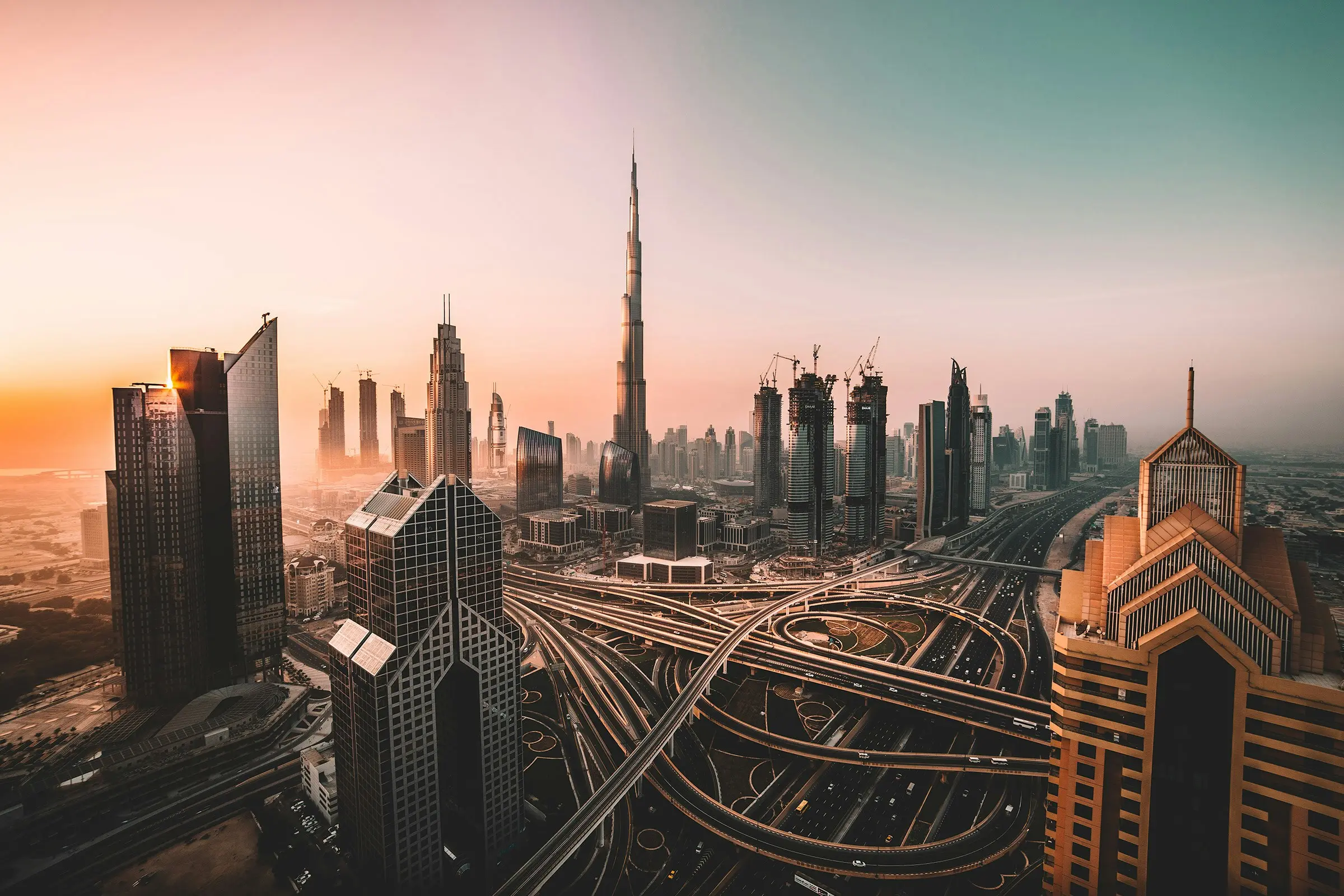
If you watch global news channels, the Middle East is often portrayed as a region characterized by volatility and geopolitical tension. However, if you stand on the ground in Dubai South or walk through the active construction zones of the city's master communities in 2026, the contrast is stark.
Cranes continue to move, concrete is poured around the clock, and the billions of dollars allocated to Dubai's future are actively deployed. Rather than retrenching or slowing down in response to regional headlines, Dubai has accelerated its long-term development plans.
The cornerstone of this resilience is the Dubai Economic Agenda (D33), a bold ten-year roadmap designed to double the size of the emirate's economy by 2033. By tying real estate growth directly to public infrastructure spending, Dubai ensures that its physical expansion remains systematically insulated from temporary regional conflicts.

TL;DR / Key Takeaways
- The D33 Economic Roadmap: Dubai's Economic Agenda (D33) aims to double the size of the economy, targeting a cumulative GDP of AED 32 trillion by 2033.
- The Al Maktoum Airport Expansion: Approved at a budget of AED 128 billion ($35 billion USD), DWC is designed to be the world's largest airport, handling up to 260 million passengers annually.
- Neutral Safe-Haven Appeal: International investors view Dubai similarly to Singapore or Switzerland—a politically neutral hub with dollar-pegged security and world-class logistics.
- Infrastructure-Led Growth: Continued state-backed spending on public projects guarantees sustained housing demand and capital appreciation in designated expansion zones.
The Disconnect Between News and Reality
For international real estate investors, media reports can create an illusion of market risk. Yet, the physical reality in Dubai is entirely different. One week into any regional tension, logistics and construction contracts proceed without a single delay.
This resilience is not accidental. The UAE government operates on decadal planning cycles that are structurally decoupled from short-term geopolitical noise. Large-scale public works are funded by robust state reserves, sovereign wealth allocations, and cash-heavy capital inflows from global investors seeking a safe haven. As a result, Dubai's construction timelines remain intact.
The Dubai Economic Agenda (D33): Doubling GDP by 2033
Launched in 2023 by Sheikh Mohammed bin Rashid Al Maktoum, the D33 Agenda is a comprehensive economic roadmap that aims to double Dubai's GDP to AED 32 trillion by 2033.
Key pillars of the D33 agenda include:
- Foreign Trade Expansion: Doubling foreign trade to reach AED 25.6 trillion by 2033, integrating 400 new cities into Dubai's trade network.
- Foreign Direct Investment (FDI) Sinks: Generating over AED 650 billion in FDI over the decade, supported by regulatory reforms and advanced technology free zones.
- Digital Economy Focus: Positioning Dubai as a leading global digital hub, creating thousands of jobs in artificial intelligence, blockchain, and green tech.
For real estate, D33 provides a guaranteed demand buffer. To double its economy, Dubai is actively expanding its workforce and attracting high-net-worth individuals (HNWIs). This influx of permanent residents translates directly into sustained demand for residential, commercial, and retail properties.
The Al Maktoum International Airport (DWC) Expansion
The most visible proof of Dubai’s long-term infrastructure commitment is the expansion of Al Maktoum International Airport (DWC) in Dubai South. Approved in April 2024 with a budget of AED 128 billion ($35 billion USD), this mega-project is designed to create the world's largest airport.
Key metrics of the DWC expansion:
- Passenger Capacity: Designed to handle up to 260 million passengers annually, five times the size of the current Dubai International Airport (DXB).
- Physical Scale: Covering 70 square kilometers, featuring 5 parallel runways and 400 aircraft contact gates.
- Logistical Consolidation: Merging aviation, logistics, and marine transport via the nearby Jebel Ali Port, creating a global supply chain corridor.
The construction of DWC is proceeding on schedule, with the first phase set to handle 150 million passengers within the next decade. For real estate investors, this airport is the anchor for the entire Dubai South and Expo City master communities. Properties in these areas are positioned to benefit from significant long-term capital appreciation as operations gradually transfer from DXB to DWC.

Why Dubai's Mega-Projects Are Insulated from Geopolitics
Several structural factors protect Dubai's mega-projects from regional disruptions:
- Political Neutrality: The UAE maintains active diplomatic relations and political neutrality, positioning itself as a secure execution hub for international business.
- Cash-Heavy Capital Structure: A high percentage of real estate and commercial transactions are conducted in cash or funded via non-leveraged equity, shielding projects from debt market volatility.
- Escrow Security: The Real Estate Regulatory Agency (RERA) enforces strict escrow account laws. Developers cannot access investor funds unless specific construction milestones are independently verified, preventing projects from stalling.
- Sovereign Backing: The UAE's sovereign wealth funds (such as ICD and ADIA) provide massive capital reserves to back critical transport, utility, and tourism infrastructure.
Master Communities Tied to D33 Growth
To capitalize on D33-driven growth, investors should focus on master-planned communities adjacent to major infrastructure upgrades:
- Dubai South: The primary beneficiary of the DWC airport expansion and Jebel Ali logistics corridor. Offers affordable to mid-market residential units with high yield potential.
- Dubai Creek Harbour: Emaar's flagship master development, designed as a smart, pedestrian-friendly city center linked to the D33 digital expansion.
- Expo City Dubai: Re-purposed as a green, tech-focused business hub, attracting multinational corporations and international clean-energy investments.
Frequently Asked Questions
What is the primary goal of the Dubai Economic Agenda (D33)?
The primary goal of the D33 agenda is to double the size of Dubai's economy by 2033, targeting a cumulative economic output (GDP) of AED 32 trillion. It focuses on doubling foreign trade, attracting AED 650 billion in FDI, and expanding the digital economy.
How much will the Al Maktoum International Airport expansion cost?
The expansion of Al Maktoum International Airport (DWC) is budgeted at AED 128 billion (approximately $35 billion USD). It was approved by Sheikh Mohammed bin Rashid Al Maktoum in April 2024 and will be built in phases over the coming decade.
What is the passenger capacity of the new Al Maktoum Airport?
Upon completion, the new passenger terminal at Al Maktoum International Airport (DWC) will have a maximum capacity of 260 million passengers annually, featuring 400 aircraft gates and five parallel runways.
How does government infrastructure spending protect real estate investors?
State-backed spending on transport hubs, roads, and utilities guarantees job creation and population growth. As these public projects mature, nearby properties experience increased demand, rising occupancy rates, and capital appreciation, providing a safety net for buyers.
How can Sophia AI help me target D33-related opportunities?
Sophia AI monitors live listings, historical DLD transaction databases, and active mortgage registry databases on a daily basis. This allows for real-time tracking of net rental yields by factoring in the Mollak service charge index for specific buildings, which varies substantially even within the same neighborhood. For example, in Downtown Dubai, service charges can range from AED 15 to AED 45 per square foot, dramatically altering the net profitability of an investment. By querying Sophia, buyers can access these granular datasets instantly to make informed decisions.
Sources and further reading
- Dubai Government D33 Economic Agenda Portal
- Dubai Land Department (DLD)
- Al Jazeera: Dubai approves building new terminal at Al Maktoum Airport
- Wikipedia: Al Maktoum International Airport
- RERA Escrow Account Regulations
Practical due diligence checklist
Use this article as a shortlist filter, then validate the specific asset before making a decision. Confirm the current asking price against recent transactions, check the total acquisition cost rather than only the headline price, and review service charges, payment-plan obligations, handover assumptions, and resale liquidity. For off-plan purchases, verify escrow registration, construction progress, developer delivery history, and the exact clauses in the sales and purchase agreement. For ready property, inspect the unit condition, building maintenance, occupancy profile, parking, views, and realistic rental demand.
Before committing, compare at least three alternatives in the same budget band. The strongest option is usually the one where location, entry price, floor plan, developer quality, future supply, and exit strategy all align. Avoid relying on generic area averages or marketing brochures when unit-level evidence is available.
How to turn this guide into a decision
Use this article to form a shortlist, then test each option against current evidence. Check recent transactions, live asking prices, payment terms, service charges, handover assumptions, rental demand, and resale liquidity. A good Dubai property decision depends on the exact asset, not only the area, developer, or broad market narrative.
For investors, compare total acquisition cost and holding cost before looking at headline returns. Include DLD fees, agency fees, service charges, maintenance, vacancy, furnishing, management, and potential exit costs. For end users, compare livability factors such as commute, noise, parking, amenities, building quality, and future construction nearby.
The safest decision process has four steps: verify the data, compare alternatives, pressure-test the downside, and confirm all terms in writing. If a property still looks attractive after those checks, it is a stronger candidate. If the numbers only work under optimistic assumptions, keep searching or negotiate better terms.
Frequently Asked Questions
What is the primary goal of the Dubai Economic Agenda (D33)?
The primary goal of the D33 agenda is to double the size of Dubai's economy by 2033, targeting a cumulative economic output (GDP) of AED 32 trillion. It focuses on doubling foreign trade, attracting AED 650 billion in FDI, and expanding the digital economy.
How much will the Al Maktoum International Airport expansion cost?
The expansion of Al Maktoum International Airport (DWC) is budgeted at AED 128 billion (approximately $35 billion USD). It was approved by Sheikh Mohammed bin Rashid Al Maktoum in April 2024 and will be built in phases over the coming decade.
What is the passenger capacity of the new Al Maktoum Airport?
Upon completion, the new passenger terminal at Al Maktoum International Airport (DWC) will have a maximum capacity of 260 million passengers annually, featuring 400 aircraft gates and five parallel runways.
How does government infrastructure spending protect real estate investors?
State-backed spending on transport hubs, roads, and utilities guarantees job creation and population growth. As these public projects mature, nearby properties experience increased demand, rising occupancy rates, and capital appreciation, providing a safety net for buyers.
How can Sophia AI help me target D33-related opportunities?
Sophia AI monitors live listings, historical DLD transaction databases, and active mortgage registry databases on a daily basis. This allows for real-time tracking of net rental yields by factoring in the Mollak service charge index for specific buildings, which varies substantially even within the same neighborhood. For example, in Downtown Dubai, service charges can range from AED 15 to AED 45 per square foot, dramatically altering the net profitability of an investment. By querying Sophia, buyers can access these granular datasets instantly to make informed decisions.
Genie AI
AI Property AdvisorGenie AI is an advanced artificial intelligence system that analyzes thousands of data points to provide personalized real estate investment recommendations. Powered by Dubai Land Department data, market trends, and sophisticated algorithms, Genie AI helps investors make data-driven decisions.
Related Articles
Dubai Property Market News: This Week's Transaction, Listing and Source Dates
A date-aware Dubai property market news guide separating DLD registration reporting, portal asking-price observations, and developer availability snapshots for the 17–22 August 2026 reporting period.
Market NewsCedre Villas in Dubai Silicon Oasis: Buyer Research Guide
A source-aware guide to researching Cedre Villas in Dubai Silicon Oasis: documented home formats and sizes, dated portal asking-price examples, comparison questions and unit-specific due diligence.
Market NewsHow to Ask Sophia a Property Research Question in Dubai
A practical Dubai property-research framework: define your goal, location, requirements, budget, timing, constraints and desired output, then separate published information from details needing advisor or official confirmation.
Ready to Invest in Dubai?
Use Sophia AI to compare Dubai property options based on your budget, goals, and preferences.
Ask Sophia AI